
When you’re first learning radicals, it can feel confusing to:
remember the order of the steps
figure out which numbers go inside or outside the radical
understand why the process works
To make it easier, there are two simple steps you can follow every time you simplify a radical.
 Once you practice these steps a few times, the process will start to feel much more natural and manageable.
What Is a Radical?
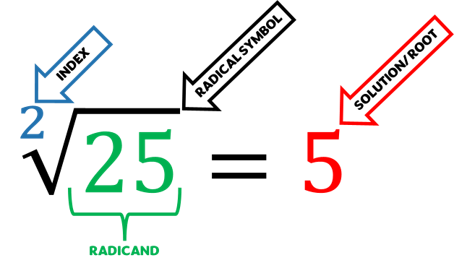 Images in this Byte were created by Wendy McMillan in PowerPoint. To hear an audio description of the image above, click play on the audio player below.
A radical is an expression that represents the root of a number or an expression with a variable. It is written using the radical symbol (√).
The index tells you which root you're taking:
If there is no number written as the index, it is understood to be 2, meaning you take the square root.
An index of 3 means you take the cube root.
An index of 4 means the fourth root, 5 means the fifth root, and so on.
The radicand is the number or expression inside the radical symbol — the value you're finding the root of.
The root (or solution) is the final answer after evaluating the radical.
What Are Root Numbers?
Radicals can represent square roots, cube roots, and higher roots. A root number is simply the answer you get after evaluating a radical.
For example, in √16 = 4, the number 4 is the root number because it is the solution to the radical.
A square root has the same number multiplied by itself. In other words, it has two identical factors. 🟨
For example:
2 x 2 = 4
5 x 5 = 25
A cube root has the same number multiplied by itself three times. It has three identical factors. 🧊
For example:
2 x 2 x 2 = 6
3 x 3 x 3 = 27
This pattern continues for higher roots. 📔
Fourth roots multiply the same number four times.
Fifth roots multiply the same number five times.
 Here are some common perfect squares you should know.
Knowing these perfect squares will make simplifying a radical much easier and faster:
2 x 2 = 4
4 x 4 = 16
5 x 5 = 25
6 x 6 = 36
7 x 7 = 49
8 x 8 = 64
9 x 9 = 81
10 x 10 = 100
11 x 11 = 121
12 x 12 = 144
Quiz
What index would you need to take to find the root of 625?
How to Simplify a Radical: 2 Steps
 When simplifying a square root (radical), the goal is to make the number inside the radical as small as possible by factoring out perfect squares. The number that remains inside the radical should still be a whole number.
Also, remember that the square roots of negative numbers aren't real numbers, so the number inside the radical should not be negative.
Let’s look at an example using √45.
The number 45 isn't a perfect square. We know this because:
6 x 6 = 36
7 x 7 = 49
Since 45 falls between 36 and 49, its square root isn't a whole number.
 To simplify √45:
Step 1: Break 45 into its factor pairs and look for a pair that contains a perfect square.
Factors of 45:
1 x 45
3 x 15
5 x 9
The pair 5 × 9 is useful because 9 is a perfect square.
Step 2: Rewrite the radical.
 Now, you can take 3 out of the radical, since √9 = 3.
 The radical is now simplified because there are no perfect square factors left inside the radical.

That's it! The radical is simplified!
How to Simplify a Variable Radical
What happens when you have an expression like this?
 This is called a variable expression because it has an unknown (variable) value.
 For variable expressions:
You’ll need to use the laws of exponents to understand how to find the root of a variable raised to a power.
For example, if you want to work with x⁶, think about how it can be written as a power raised to another power. This means identifying the factors of 6.
In other words, you can rewrite x⁶ as a power of a power, such as:
 The rule is to multiply x by itself m times. Then repeat the result n times. 𝑥^3 means multiply x three times, then repeat that result twice.
 Find the factors of each:
The factors of 32 are 1 & 32, 2 & 16, 4 & 8
The factors we need are 2 & 16 (since 16 is a perfect square)
The factors of x⁶ are (x³)² (from the law of exponents rule)
 Take the root of each:
Since this problem is a square root, you're looking for a number (or variable expression) multiplied by itself.
For 32, the factor 16 is 4 x 4. We take the root number (4), and we're left with √2
For the variable expression, that will be x³
The answer becomes:

Take Action
Now it's your turn to simplify a radical expression!
 Remember:
Check out these resources to learn more:
Your feedback matters to us.
This Byte helped me better understand the topic.