
You’re in a job interview, and everything feels steady — until you’re suddenly asked one of the most revealing questions:
How do you handle unexpected changes in your work?
Interviewers listen closely to what you say next.
 Your response shows how you think and work under pressure.
Answers to Avoid
Emotion Instead of Action

I feel some pressure at the start, but I stay calm and positive in my work.
This focuses on feelings rather than decisions or actions.
Adaptability Without Ownership

I’m used to last-minute changes and can handle them.
This suggests reacting to problems instead of managing them.
Reasoning Over Responsibility

When changes happen, it’s usually because requirements weren’t clear.
This may be true, but it sounds like blaming others.
How to Answer
Use the STAR framework as shown below:
Situation
Briefly describe what changed.
Example:
I had already prepared my final semester presentation when the professor shared a new template a few hours before the deadline.
 Illustration from IllustrationKit, modified by the author.
Task
Explain what you were responsible for after the change.
Example:
I needed to update my presentation to match the template and submit it on time.
 Illustration from IllustrationKit, modified by the author.
Action
Describe what you actually did.
Example:
I updated the key sections first and adjusted the layout to fit the template. I then did a final review to ensure no content was missing.
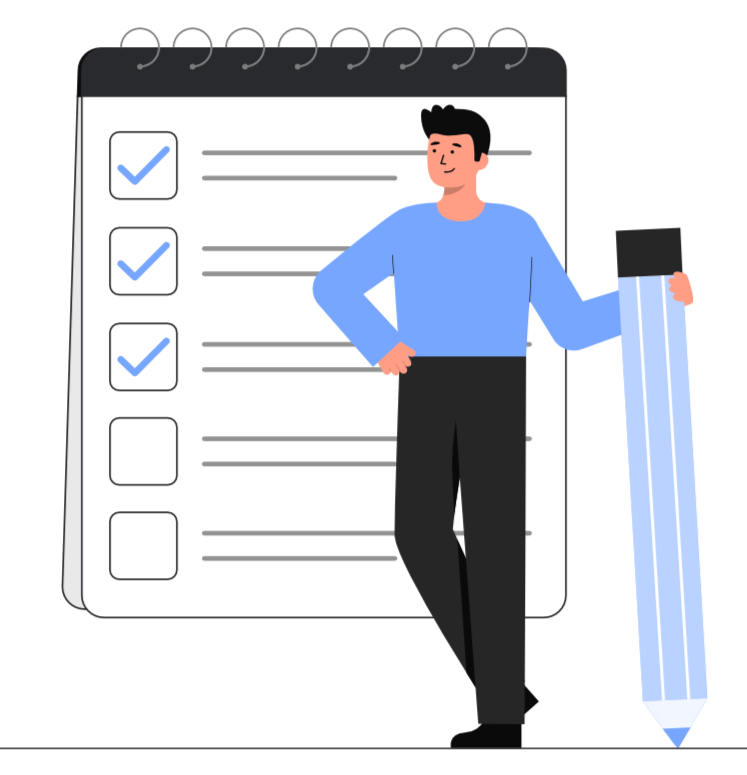 Illustration from IllustrationKit, modified by the author.
Result
Explain the outcome of your actions.
Example:
I submitted the presentation on time and received positive feedback for following the guidelines and presenting the content clearly.
 Illustration from IllustrationKit, modified by the author.
What Your Answer Should Show
Prioritization and Communication
The previous example shows prioritization by updating the key sections first.
In a group project, you would also communicate what you can and can't complete. This helps set realistic expectations for the team.
Learning and Improvement
The example shows learning to adapt quickly and improving how tasks were adjusted under time pressure.
Brief Situation and Task
The example explains what changed and what needed to be done without unnecessary detail.
Specific Actions
The example describes the steps taken in detail, which is what interviewers care about.
Clear Result
The example states what happened and why it mattered, showing an observable outcome. Vague results such as “everything worked out” or “the project went well” don’t show impact.
Scenario
Meet Maya. She’s a software engineer attending a job interview.
 The interviewer asks her how she handles unexpected changes at work.
Which response should Maya choose?
Option A
During a project, my manager asked me to add a new feature close to the deadline. I reorganized my tasks and worked on the new feature first, while keeping the team informed.
Option B
During a project, my manager requested an additional feature near the deadline. I already had other tasks in progress, so I adjusted my plan to fit it in.
Option C
During a project, my manager requested a last-minute feature. I worked on it first, checked what else I could complete, and communicated this to the team. In the end, the most important work was delivered on time, and the team had clear visibility. This taught me the importance of prioritizing my work and keeping the team informed.
Quiz
In the scenario above, which response is the strongest?
Take Action

Your feedback matters to us.
This Byte helped me better understand the topic.